The Dragon in the Window: Why St Margaret of Antioch Still Speaks to London
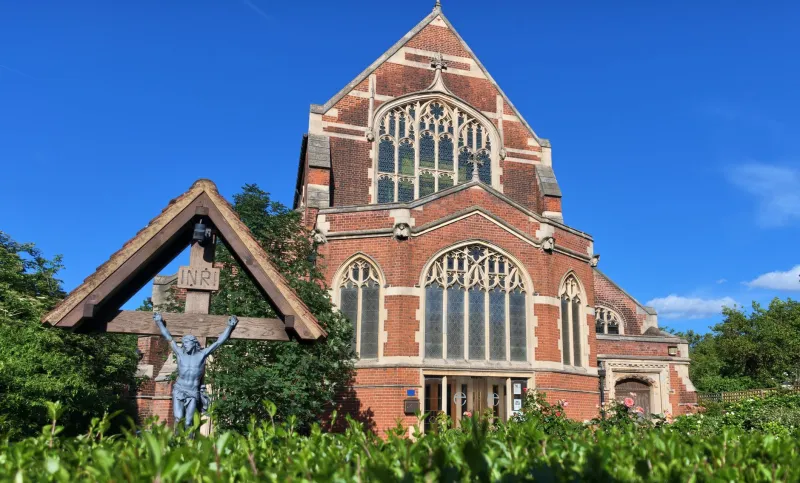
St Margaret of Antioch is not the easiest saint to explain at a dinner party. She is not a familiar figure like St Paul or St Francis, and her most famous story involves a dragon. Yet her name has been carried by churches across England for centuries, including our own. Her feast day on 20 July is a reminder that a medieval legend can still ask searching questions of a modern city.
Who was Margaret of Antioch?
Margaret belongs to the early Church in Antioch, in what is now Turkey. The historical details are uncertain. The earliest surviving accounts of her life date from centuries after the period in which she is said to have lived, and they blend memory, devotion and storytelling. That does not make her story unimportant. It makes it a window into how Christians have long imagined courage.
The legend tells of a young Christian woman, the daughter of a pagan priest. She embraced the faith and refused marriage to a powerful governor named Olybrius. For that refusal she was imprisoned, tortured and eventually beheaded. In the most famous episode, a dragon appears in her cell and swallows her. She is holding a small cross, and the dragon releases her — or bursts apart, depending on the version. It is a strange and vivid tale, and it has never quite been forgotten.
Why a dragon-slaying saint for a London parish?
Most of us are not called to face literal dragons. But dragons are useful images. They stand for the things that loom large and frighten us: debt, grief, illness, loneliness, pressure at work, the feeling of being trapped. Margaret's story is not a celebration of violence. It is a portrait of someone who holds on to faith when the powerful tell her to let go.
In a city that moves quickly and often asks people to prove themselves, her witness is oddly contemporary. She was young. She was not wealthy or influential. She stood before a man with authority and refused to let fear have the last word. That is not only a story for stained glass. It is a story for anyone who has ever had to be brave in a small room.
A short guide to Margaret in our church
Visitors often ask what to look for when they see Margaret in art. Here is a simple guide to the symbols that usually surround her.
- The dragon: often at her feet, or beneath her. It is not a trophy so much as a sign that faith can face what frightens us. Look for the way the dragon is placed — sometimes crushed, sometimes merely present.
- The cross: usually held in her hand. It is the instrument of Christ's victory, not a weapon of her own making. In Margaret's story, the cross is what breaks the dragon's hold.
- The crown: a sign of martyrdom and dignity. Medieval artists often showed her as a princess, reminding viewers that she was a person of worth even when the world treated her as disposable.
- The palm branch: an ancient Christian symbol of martyrdom. It speaks of victory through faithfulness rather than through force.
- The book: the Gospel. Margaret's courage is presented as rooted in the word of God, not simply in her own strength.
- Her youth: she is often depicted as a young woman. That detail matters. Courage is not reserved for the old, the expert or the obviously powerful.
In our own church, Margaret appears in the stained glass and in a small icon near the side chapel. The next time you are here, take a slow look. Ask what the artist has chosen to emphasise. Is the dragon small or large? Is her face calm or defiant? Does she look like a princess, a prisoner or a saint? The answers change how the story speaks.
From ancient Antioch to everyday London
At St Margaret of Antioch, the saint's name is not a museum label. It shapes how we try to be a community. Her story invites us to ask who in our city is being pressed to give up their dignity, and who needs someone to stand alongside them. It reminds us that faith is not only about what we believe in private. It is also about how we treat the person beside us.
That is why the old legend still has a place in a London parish. We are not called to slay dragons in the dramatic sense. We are called to notice the neighbour who is struggling, to make room at the table, to keep showing up when it would be easier to disappear. Margaret's courage was exercised in a prison cell. Ours is often exercised in a queue, a hospital corridor, a school gate or a phone call we have been putting off.
Come and see
You do not have to wait for 20 July to explore her story. Drop in during the week, come to a Sunday service or simply sit for a few minutes in front of the window. If you would like to know more, speak to one of the welcome team or pick up a short guide to the church's art and history.
The dragon in the window is not there to frighten us. It is there to remind us that courage and friendship belong together, and that even a medieval saint can still speak to a modern city.