The Coffee Rota Is Not a Small Thing: Six Ordinary Jobs That Hold St Margaret's Together
Every church has a secret second building inside it. Not the crypt, not the vestry. The rota.
At St Margaret's, the rota lives on a clipboard on the hook by the kitchen door, and it is the closest thing we have to an organisational chart. It tells you who is opening up, who is on coffee, who is doing the flowers for the wedding on Saturday, and who has the key to the hall cupboard that sticks.
We are often asked, usually by someone new and slightly nervous, "how do I get involved?" The honest answer is: pick a job that fits your actual life, not the life you think you should have. So here is a straight account of the six roles that do most of the work — what they really ask of you, and what people get out of them.
1. The coffee rota
Time: about 45 minutes, roughly once every six weeks.
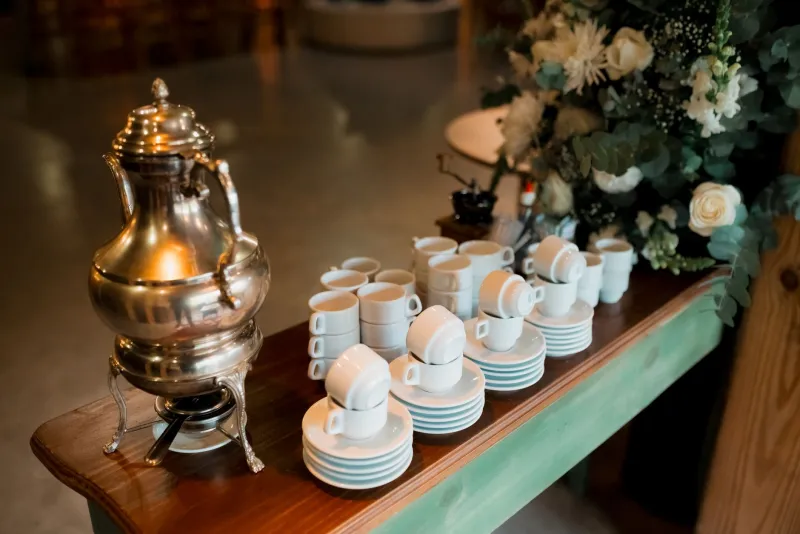
You put the urns on before the service ends, set out the cups, and stand behind a table for half an hour saying good morning to people. Then you wash up, with help, because someone always helps.
That is the whole job. But it is also the job where you will meet everybody. Keith, who has been on the rota since 2011, says: "I don't do theology. I do tea. But I've been at every christening and every funeral in this building for fifteen years because I'm the one at the table at the end. You hear things. You notice when someone's not right."
If you are new and want to learn names quickly, this is the fastest route in. No skill required beyond remembering roughly how a kettle works.
2. The welcome desk
Time: one Sunday morning a month, 9.45am to 12.15pm, shared with a second person.
Standing in the porch, handing out service sheets, answering questions like "where are the loos" and "is this seat taken" and, most weeks, "is there a bus stop near here".
It sounds thin. It is not. Rosalind, who coordinates the desk, reckons that about a third of the people who now call St Margaret's home first spoke to somebody on that desk. "Nobody remembers the sermon," she says. "Everybody remembers whether somebody said hello before it started."
You do need to be reasonably comfortable with strangers. You do not need to know anything about the church — there is a folder under the desk with every answer in it.
3. Flowers
Time: two to three hours, about four times a year, plus the big occasions at Christmas and Easter.
Arranging, conditioning, wrestling with oasis, hoovering up afterwards. It happens on a Saturday, which suits people who work Sundays and people who like a quiet morning with the building to themselves.
Tom took it on after he retired and found, to his surprise, that it was the most sociable thing he did all week. "You're in and out of the vestry, someone's making tea, somebody's setting up for a baptism, and before you know it it's two o'clock. I came for the flowers. I stayed for the company."
No experience is needed. There is a small group who will show you once, and then you will be shown again until you have it.
4. Hall set-up and pack-down
Time: 90 minutes, ad hoc, roughly monthly.
Chairs out, tables up, the big urn filled, the heating on an hour before anyone arrives. Then the reverse afterwards, in half the time, because everyone wants to go home.
This is the least glamorous job on the list and the one that gets thanked least, and it is also the one that makes everything else possible. Toddler group, the bereavement tea, the winter warm hub, the community lunch: none of them happen without someone stacking chairs on a Friday afternoon.
It suits people who would rather be doing than chatting. If you are the sort of person who quietly tidies up at parties, this is your natural habitat.
5. The phone rota
Time: three phone calls a month, whenever suits you.
Once a month, ring three people from the congregation who live alone or who have asked to be rung. Fifteen minutes each. How are you, how's the knee, do you need anything brought round, we missed you on Sunday.
Amina has done this for four years and describes it as the easiest thing she has ever agreed to. "I was terrified the first time. What do you say to someone you don't know? Turns out you say, 'hello, it's Amina from church,' and they say, 'oh lovely, how are you?' and off you go."
It is also, quietly, the job that catches things early. Two of our volunteers have flagged concerns that turned out to matter. That is not a small thing.
6. The pew-sheet folding
Time: Thursday mornings, or whenever suits, about an hour.
Photocopying, folding, counting, stacking. It happens in the side room with the good light and the slightly temperamental copier, usually with the radio on and a kettle going.
Derek does it because, in his words, "it's the only job where you can sit down, be useful, and nobody expects you to be interesting." That is, genuinely, the appeal for a lot of people.
What nobody tells you about volunteering
The jobs themselves are ordinary. What is not ordinary is what repetition does. Showing up on the same rota, with the same six people, for two years, is how most adult friendships in a city actually get made. Not through a big commitment. Through a small one, done again.
So: no guilt. If you have a season of life where none of this fits — a new baby, a sick parent, two jobs — that is not a failure, and there is no list of names of people who have not volunteered. There is just a clipboard, and it will still be there in six months.
If you would like to try something
- Have a look at the clipboard by the kitchen door on any Sunday. It is not secret.
- Speak to whoever is on coffee. They will point you to the right coordinator.
- Email the parish office and say what kind of thing you fancy and how often. "Once a quarter, something physical" is a perfectly good answer.
- Try it for three months. That is the informal agreement. Nobody is asking for a lifetime.
We would rather have forty people doing a little than six doing everything. That has been the principle at St Margaret's for as long as anyone can remember, and it has not let us down yet.