The Third Row from the Back: A Friendly Field Guide to Seats and Belonging at St Margaret’s
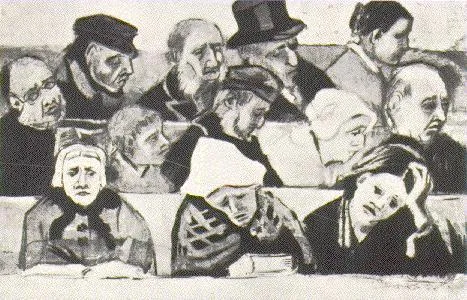
Photo: Vincent van Gogh, Public domain, via Wikimedia Commons
On a damp November Sunday in 2026, the third row from the back on the left-hand side of St Margaret’s is already speaking. A folded cream cardigan sits on the pew. Beside it, a walking stick leans at an angle that suggests it knows the building better than most of us. Nobody has put out a reserved sign. Nobody needs to. By ten to eleven, the regulars are reading the room the way other Londoners read a Tube carriage: who is standing, who needs a hand, and where there is still a comfortable place to land.
Why a Seat Matters More Than It Should
London is a city of negotiated space. We shuffle along escalators, tuck our bags under café tables and apologise to strangers for existing near them on the Central line. A church pew ought to be simpler. There is, after all, usually room. But ask anyone who has slipped into the same spot for twenty years and you will hear something deeper than habit. A familiar seat is a small anchor. It says: I know where to put my coat, I know how the light falls, and I know I am not in anyone’s way.
That last part matters. At St Margaret’s, the quiet claiming of a seat is rarely about territory. It is about settling. It is about arriving with a hundred small worries and finding one thing already decided. For some, it is the aisle seat near the back, handy for a quick exit if the sermon runs long or the knees object. For others, it is the front row, where the words are clear and the candles are close enough to watch. Neither is holier. Both are human.
The Unwritten Map
Every congregation has a map that no one has drawn. At St Margaret’s, the back rows tend to gather families with buggies, latecomers and anyone who likes to keep one eye on the door. The side aisle is a favourite for people who arrive quietly and leave the same way. The middle block is a happy mix of old friends and visitors who have been gently steered there by the welcome team. The front? The front is for those who like to hear every syllable, and for children who are still learning that church is a place where wriggling is tolerated.
None of this is official. That is the point. The map shifts when the heating comes on, when a baptism fills the church, when the carol service brings in half the neighbourhood. On those days, regulars do what Londoners do best: they adapt. They slide along, stack their coats, and find a new angle on the altar. The seat was never the point. The settling was.
What Regulars Mean by ‘My Seat’
Ask a regular what ‘my seat’ means and you will get a wry smile. ‘It’s not mine,’ one parishioner told me recently, while clearly meaning every word. ‘It’s just that I pray better when I’m not thinking about where to sit.’ Another described it as muscle memory. ‘I’ve sat there through good news and bad. If I moved, I’d spend the whole service wondering what I’d forgotten.’
That is not possessiveness. It is affection. A seat becomes a witness. It holds the memory of a christening, a quiet Tuesday, a funeral where the church felt both enormous and very small. When someone says ‘my seat’, they are often saying ‘my history’. The welcome team knows this. They also know that history can be kind or clumsy, depending on how it is handled.
The Newcomer’s Dilemma
For a first-time visitor, the unwritten map can feel like a minefield. You walk in, spot a promising pew, and then notice a cushion that looks like it has been there since the Reformation. Is it taken? Is it blessed? Is it a trap? The welcome team’s approach is deliberately light. They will offer a smile, a service sheet and a choice: ‘Anywhere you like. The back is easy, the front is friendly, and the middle has the best view of the noticeboard.’
They try not to over-direct. There is a difference between hospitality and crowd control. A newcomer who is marched to a seat may feel welcomed, but also managed. A newcomer who is given two or three good options can relax. If they accidentally sit in somebody’s usual spot, the usual occupant will almost certainly smile, sit nearby and pretend it was their idea to move. That is the quiet courtesy of a church that has learned to bend.
Making Room Without Making a Fuss
So how does St Margaret’s honour the comfort of familiar places while keeping the door genuinely open? Mostly through small, unglamorous habits. Regulars leave a gap at the end of a pew. They shuffle along rather than guard the aisle. The welcome team keeps an eye out for anyone hovering, and offers a nod rather than a lecture. On busy Sundays, a few people choose to sit one row forward or one row back, just to create a soft landing for someone else.
None of this needs a policy. It needs attention. It needs the kind of community that can say, gently, ‘You’re not in the way’ and mean it. The third row from the back will still have its cardigan. But there will be room beside it. That is the invitation: come and settle, and let someone else settle too.
The Grace of a Familiar Place
A pew is not a parking space. It is a small piece of shared life. At St Margaret’s, we hope the comfort of a familiar seat never becomes a fence. We hope it becomes a porch: somewhere to pause, take off your coat, and realise you have arrived. If you are new this Sunday, take a seat. If it turns out to be someone’s favourite, they will survive. They may even be glad of the chance to make room.